
Plan your audit!
We would be happy to advise you in more detail on your desired topic. Simply send a non-binding inquiry to info@grindaix.de, and we will get back to you as soon as possible.
Scope of the audit
The scope of the audit includes a comprehensive and systematic analysis of the cooling lubricant supply for your machines and systems. Starting with a detailed assessment of the existing cooling lubricant system, the audit evaluates nozzles and outlets, pressures and flow rates, pump capacity, piping, supply systems, as well as process settings, cycles, requirements, and components. Based on this, the current actual situation is documented and presented transparently.
In addition, consumption and energy profiles are created that track both coolant consumption (pressure and volume per cycle, component, or cycle) and the energy requirements of the pumps (kWh). This allows for the identification of specific savings potentials for coolant costs and energy consumption. In a subsequent step, a comprehensive analysis of all machines in operation is conducted, including the creation of a combined consumption profile as well as a pressure and coolant supply plan for individual or centralized supply systems.
Finally, a clearly defined target state is developed, which includes options for flow-optimized pressure boosting, decentralized or centralized pressure boosting concepts, and the use of variable-speed or fixed-speed pumps. The result of the audit is a customized optimization and retrofit concept, including specific offers for grindaix retrofit packages consisting of nozzles, pumps, and optimized settings.
Benefits to you
- Longer tool life
- Higher infeed, higher feed rates
- Avoidance of grinding burn
- Reduction in Energy consumption
- Reduction in Lubricoolant volume
- Reduction in Lubricoolant costs
- Reduction in Filtration load
- Determining Coolant Pressure Scenarios and Flow Rates
- Design Parameters for Coolant Components and Filtration Systems
Machine Audit - Case Study
As part of a machine audit, all coolant-lubricant (KSS) peripheral equipment and the grinding machine are analyzed in detail, and data is collected. Based on the findings, areas for optimization are identified and presented to the company in a detailed report, enabling future improvements to be implemented.
Challenges
During a current-state analysis conducted as part of an audit at an Original Equipment Manufacturer (OEM) with high quality standards, it was determined that thermal edge damage (grinding burn) was occurring on the ground components. This damage was evident on the flat surfaces of the thrust bearings along their entire circumference. In addition, the existing process kinematics made it difficult to ensure a process-appropriate supply of cooling lubricant via a stationary nozzle. This significantly increased the risk of grinding burn formation. Analyses also revealed that up to 82% of the supplied cooling lubricant was discharged unused via a bypass. The goal of the machine audit conducted by the experts at Grindaix GmbH was to systematically identify these weak points and derive concrete optimization potential.

Customer expectations
- Analysis of the current state to provide a sound assessment of the potential for optimization
- Sustainable prevention of thermal damage to the peripheral areas of grinding components
- Optimization of the coolant supply system, taking pump and nozzle technology into account
- Reduction or efficient utilization of coolant consumption, as well as potential extension of tool life
- Development of specific recommendations for retrofitting and optimizing the existing coolant system
Procedure and Solution
During the on-site assessment, Grindaix GmbH conducted a detailed analysis of all relevant process and equipment components. These included, among other things, the machine itself, the machining task, the grinding wheels used, the supply pumps, the piping layout, the filtration system, and the consumption of coolant. All results were systematically documented and prepared for further analysis. Based on this data, a schematic coolant supply plan was created and supplemented with reliable measurement data for various scenarios and machine areas. Using these analyses, specific optimization potentials were identified and concrete measures were derived:
- Installation eines anforderungsgerechten Schleifdüsensatzes
- Anpassung und Optimierung der Leitungs- und Pumpentechnik
- Optionaler Einsatz von Sensorlösungen zur Überwachung der KSS-Versorgung
All proposed measures were developed in detail and supported by specific targets and key performance indicators to ensure a transparent basis for decision-making and efficient implementation on the customer’s side.
Products Used
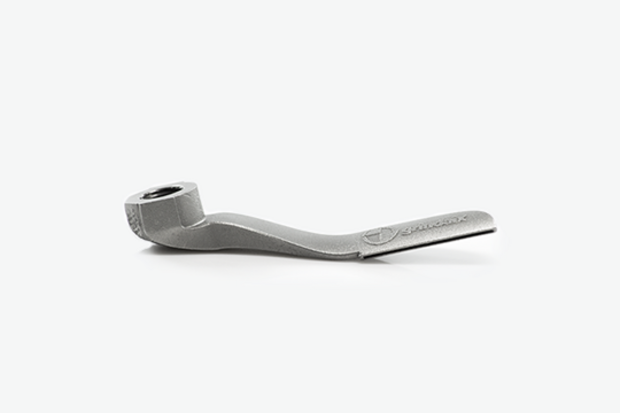
An additive-manufactured grinding nozzle, specifically tailored to the process requirements, was used. This enables a significantly improved and targeted supply of coolant to the grinding gap, thereby ensuring more effective cooling of the grinding zone. In addition, the FM GQ flow sensor, which was specifically developed for measuring abrasive media, was used. The sensor reliably indicates via optical signaling whether the cooling lubricant is flowing through the grinding process as required.